The path of the Neo-Samurai Genki Sudo

“In my first fight I wanted to be strong, get rich, and be famous. I didn’t want to lose but trample my opponents. But actually that didn’t last long.”
With legendary Dutch striker Bas Rutten in his corner, Sudo won his debut fight in bizarre fashion against Tiki Ghosn. Declared a draw, Rutten grabbed the microphone and objected to the decision. The referee sided with Rutten and declared Sudo the victor.
He later hooked up with a celebrated Japanese catch wrestling gym and competed in Pancrase. Over his six bouts in the promotion, the fighter began to find himself. Not only as a combatant but as a person. He would go 4-2 with the promotion and pick up a win over future middleweight champion Nate Marquardt. He also earned one of the more unique finishes in the history of MMA while with the promotion.

“I was filled with greed and I really wanted to get to the top. In any case, just get to the top where I’d find a wonderful place. But the higher you go, the more suffocating it is, like thin air.”
His antics and win streak earned him an invitation to compete in the UFC. Sudo won his promotional debut, and with his powerful clinch and grappling game, he’d control Leigh Remedios en route to a second-round submission. In his second bout with the promotion, Sudo lost a split decision to a young Duane Ludwig. Even in defeat, though, Sudo had captured the eyes of American fans.
He walked to the cage in Japanese theater masks while cherry blossom petals rained upon him. In the cage, Sudo danced, walked backward towards his opponents, and showcased martial skill between the theatrics. But MMA was just coming into its own in North America. The money and fame were awaiting in his homeland.
“Even though I had muscles, I felt like I wasn’t mentally strong. After turning pro, I developed mental strength.”
As his popularity rose and Sudo achieved success, the philosophy that steered him towards martial arts changed. He once stated, “the materialism of capitalist society” had trained him to put himself over others and strive to be the best. But Sudo had begun to realize his struggle was everyone’s struggle. That he was not alone on this Earth. That even his opponents were a part of him, a necessary adversary that allowed him to express himself. This led to him proudly displaying the “We Are All One Flag” after his bouts.
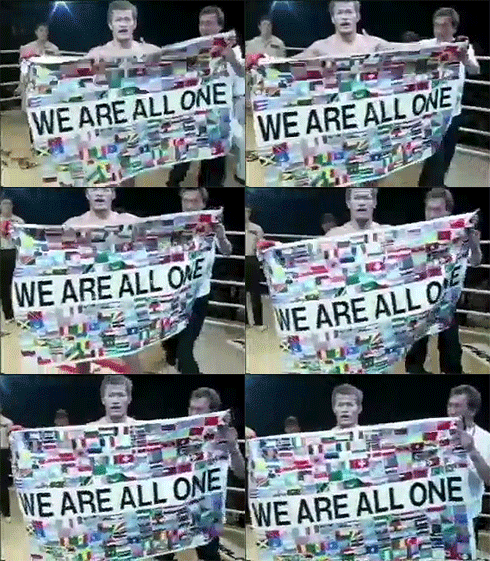
“I believe all is one to be true. The world’s conflicts and struggles result from our being separated.”
For his next bout, Sudo met 400 lb ‘King of the 4 Rounders’ Eric “Butterbean” Esch. Sudo ran circles around the knockout machine for the entire first round. In the second, “The Neo Samurai” quickly worked the behemoth to the ground and submitted him with a heel hook. The bout took place on New Year’s Eve in front of 46,000 spectators. It also aired across the country of Japan on TBS.
Sudo would call this his favorite fight because it’s the one people always bring up first on the streets. He believes that means it was the fight that entertained the most people: and in entertaining the masses, Sudo found solace.
As the shows became grander, so did the fighter’s entrances. He would often employ up to 20 background dancers and perform well-choreographed dance routines while wearing costumes.
Sudo’s mythos grew parallel to mixed martial arts worldwide. To him, this was proof of destiny being realized.
After a return stateside to choke out future world champion and all-star coach Mike Brown, Sudo went on a tear in Japan. He out-grappled and knocked out Royler Gracie in 2004 before submitting Muay Thai standout Ramon Dekkers in the first round the following year. Six months later he’d beat Kazuyuki Miyata and Hiroyuki Takaya in the same night to advance to the finals of the Hero’s Lightweight Grand Prix.
“Suffering exists when thinking about the past or the future, to live this moment, may I have a café au lait?”
Waiting for him in the finals was another surging star in Norifumi “Kid” Yamamoto. Sudo failed multiple times to take down the fellow wrestler and caught a thunderous right hand for his efforts. Yamamoto pounced and landed the final blows. All 50,000-plus in attendance exploded to their feet. Even in defeat, Sudo was smiling. He knew he had been a part of something special.
Sudo next decisioned Ole Larson and choked out Damacio Page before announcing his retirement at the annual New Year’s Eve show in 2006.
He was 28-years-old.
“In the sense of internal struggle the fight’s not over, but I’ve had enough of physical combat. Combat in the third dimension is done, so it can begin in the fourth dimension.”
After leaving MMA, Sudo spent his time as a successful wrestling coach for Japanese universities. He published multiple philosophy books that are only available in Japanese as to not lose their original meaning. Since 2009, Sudo has found success with his dance/synth-pop group World Order and amassed over 170 million views on YouTube.
In 2019, Sudo won a spot on the House of Councilors where he serves on the Committee of Agriculture, Forestry, and Fisheries.
Unorthodox would be the simplest way to describe Sudo’s fight and lifestyle. His ascension through the world of mixed martial arts and candid interviews paint a vivid tapestry of each. The performances both in and out of the ring were awe-inspiring and lined with a message of hope. The deeper Sudo went into the machismo-fueled world of cage fighting the more he rejected many of its tenants.
Sometimes you have to walk through the deepest part of the forest to find the correct path.
Casa De Luta FightKlub (Eingang im Hinterhof) Mainzer Str. 30 66111 Saarbrücken Website: https://www.bjjsaarbruecken.de/ Email: acasadeluta@gmail.com


Comments
Post a Comment